
Classical Chinese for Curious Nerds
文I like writing systems and calligraphy. A few years ago, I got sick of not being able to read Chinese. I started with learning materials for Modern Mandarin, but realized I’m more interested in ancient writings. Most English-language learning materials for Classical Chinese (and there’s not that many) assume you’ve already learned a good deal of Modern Mandarin and you’d like to polish yourself up with some literary taste. This site is for lovers of ancient languages and cultures who’d like to learn more about an extremely important ancient language that receives little attention in western studies.
Warning
This is not a guide to modern everyday Mandarin. It is a guide to ancient Chinese. Confucius. Spring and Autumn. Warring States. Maybe a little Tang Dynasty, as a treat.
Reading this to prepare for your business trip to Beijing would be pretty much exactly as helpful as studying Cicero for your beach holiday in Italy: it’s not totally unrelated, but…
Though of course, being familiar with the history of the modern language you’re learning can be very rewarding!
The first question for all Chinese learning materials: Simplified or Traditional? (If I’ve already caught you flat-footed: the mainland Chinese government implemented a script reform several decades ago, replacing some of the most complex character components with simpler alternatives based on how people tended to actually hand-write the characters in practice.)
On the one hand, Traditional is more in line with how Classical Chinese was written for over two thousand years. Actual, physical historic manuscripts are in Traditional (or one of its even more traditional ancestral forms). You need to know it to engage with any print or art object more than 70 years old (and the imitations at your local restaurant). If you’re specifically interested in Classical Chinese, you’re probably interested in old things.
On the other hand, over 95% of people who can read Chinese today were educated in Simplified and use Simplified in their daily lives. Every major Classical text and a great many minor ones are available in Simplified editions. There are more resources for learning Simplified from English. I myself am more familiar with Simplified.
I don’t think completely ignoring either is wise. Traditional forms will be given in black first, with Simplified in gray after. (To be clear for absolute beginners: they are often identical.) I have created a Cheat Sheet for the most common characters in Classical texts which differ between the two systems.
Note
There is a common misconception that Traditional forms are now illegal in the mainland. This is not true. They are still widely used for decorative purposes such as logos, book covers, calligraphy, and anything meant to feel old-fashioned. Reprinting historical books in their original Traditional is also fine. It is still the everyday script in Hong Kong specifically, and of course in Taiwan.
However, do note that using either Traditional or Simplified in culturally inappropriate contexts may annoy or offend people.
Misconceptions
You’re probably under the impression that the Chinese writing system is insanely difficult. I was certainly scared of it for years before I decided it was time to get over it and get serious. But think of it this way: there are a billion and a half people in the world, right now, who can read Chinese. They include people from all walks of life and all levels of academic interest. The system has been in use for thousands of years and it has resisted all attempts to completely replace it with phonetic scripts because people like it. The inevitable conclusion is that it’s not as hard as it seems from the outside, before you understand its organizational principles.
You’ve probably also heard scary numbers like “over 50,000 characters.” That’s technically true, but not in a way that matters: like 40,000 of those are “how one single guy signed his name 800 years ago” or “they probably weren’t sure how to write the name of some herb and improvised,” but they made it into someone’s list of rare characters and were dutifully copied into academic dictionaries. Most people know between 3000 and 5000 characters, and like all languages, there’s a fairly small core of extremely common words that appear in almost every paragraph. Focus on easily recognizing and understanding the core. Don’t worry about the long tail of rare characters: you just look them up as you go, and if you run into them a few different times, you’ll remember them.
I’ve had native Chinese speakers tell me that Classical Chinese is too hard “for a beginner” and shouldn’t be attempted without near-native fluency in the modern language. I found that puzzling, because I was already understanding it quite well. I realized that for them, the many important changes in word meaning and grammar over the last few thousand years are a real headache: I have seen the word 是 thousands of times but they’ve seen and heard it millions of times, 99.9% of them in the modern usage of “is/are”; in ancient times it was not a verb of existence but the pronoun “this.” Naturally, the modern everyday sense of words and grammar predominates for them, and untangling ancient sentences from this instinct can be very difficult. I think starting from scratch actually gives you an advantage in this respect! There is no reason you can’t learn Classical Chinese from English, just like there’s no reason you can’t learn Sumerian or Hittite or Sanskrit.
Note
Being able to read modern Chinese is definitely very helpful in that there are abundant “for dummies” resources for Chinese high school and university students to help them understand important Classical texts, as well as extensive reference works for specialists. Part of the purpose of this website is to convey into English some of this “intelligible to a fourteen-year-old who has a literature test tomorrow” information that I got from books I scrounged up on Ali Express.
TODO ancient pronunciation
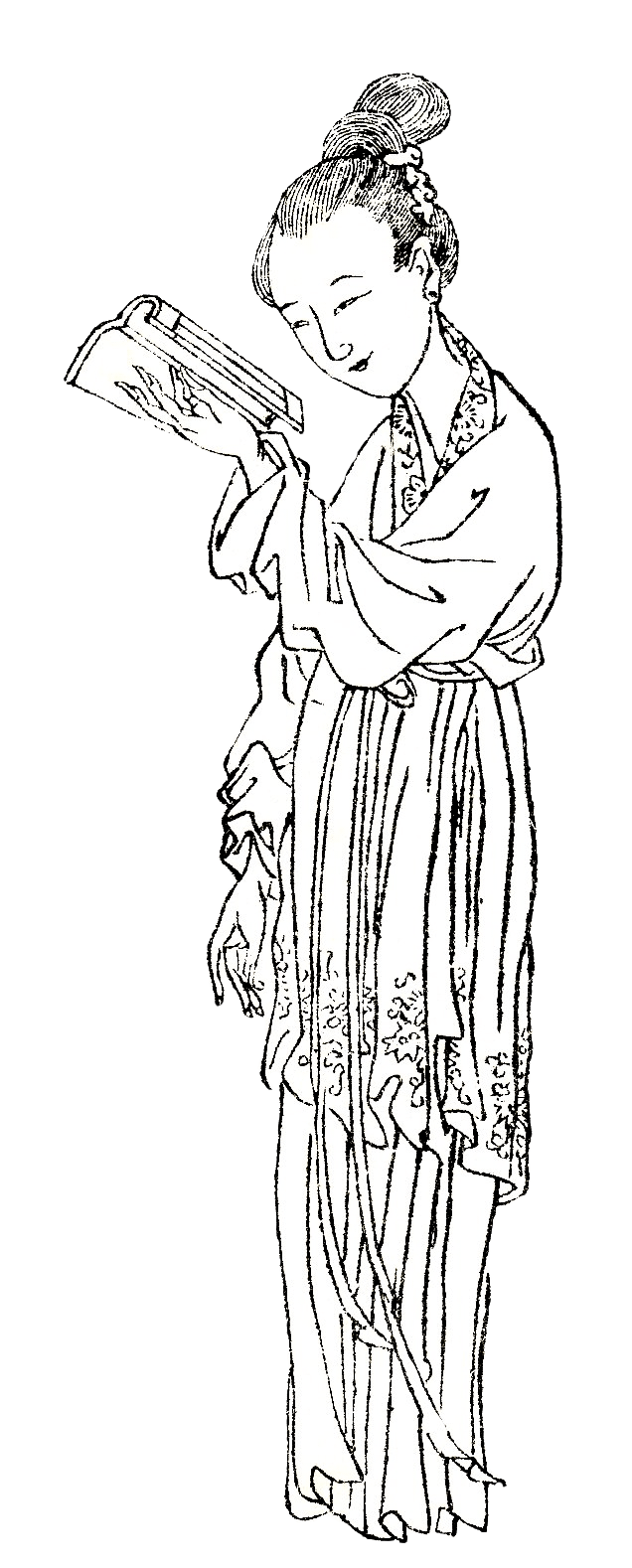
One more misconception that’s close to my womanly heart: it’s commonly assumed that in ancient China, girls were not allowed to read or write. This is emphatically not true, and abundantly contradicted by the evidence. What is true is that girls were generally not allowed to attend school to study in groups under a professional teacher, for the usual “too distracting!” nonsense reasons. Hence, a girl would only be literate if someone were able to take the time to teach her in private at home. (One of China’s most popular fairy tales – over a thousand years old – is about a girl disguising herself as a boy to get the best possible education, and she excels.)
Women writers are thinly attested at the oldest layers, since we only have the most widely copied reference texts and little in the way of interpersonal letters, everyday household management and private poetry, though almost certainly some of the anonymous folk poems in the Odes/Classic of Poetry were originally composed by women. The closer you get to the present, the more broad a sample of writing we have, and the more women appear. There are books in Classical Chinese written by women for the education of girls. The women of the Yao culture in Jiangyong even developed their own syllabic script, Nüshu (“women’s writings”) to facilitate communication and education independent of the approval of men in an especially patriarchal context. Patriarchy perpetuates itself in part by ignoring, downplaying or destroying everything women have written and have accomplished in the past; never believe that any culture was so thoroughly patriarchal that women universally resigned themselves to nonexistence, or that not a single man ever took a woman seriously.
Plan for This Site
My intention is to flesh out this introduction a bit more, add a guide to the writing system’s organizational principles, a guide to the basics of Classical grammar, and an educational tour of the Three Character Classic, which was used in antiquity to teach reading to children.
I also want to translate as much as possible into a modern, comprehensible style under a Creative Commons noncommerical license, because the public domain options are dire. I have started the Analects translation, you can read what I have so far.
I’ve also started the Resources for learning Classical Chinese from English.
Until I write it up more formally, here is a social-media-sized crash course on the writing system that I posted…
文以载道
literature leads the way through life.