The Analects of Confucius
This translation and commentary may be noncommercially used under CC BY-NC-SA 4.0. For attribution, you may call me 0xabad1dea (if you’re cool) or Melissa Elliott Arres (if you’re a coward). I spell my name in Chinese as 奥蜜蜂. The illustrations are by Irasutoya and not included in the Creative Commons license.
This is a work in progress! The full text is twenty chapters.
Background
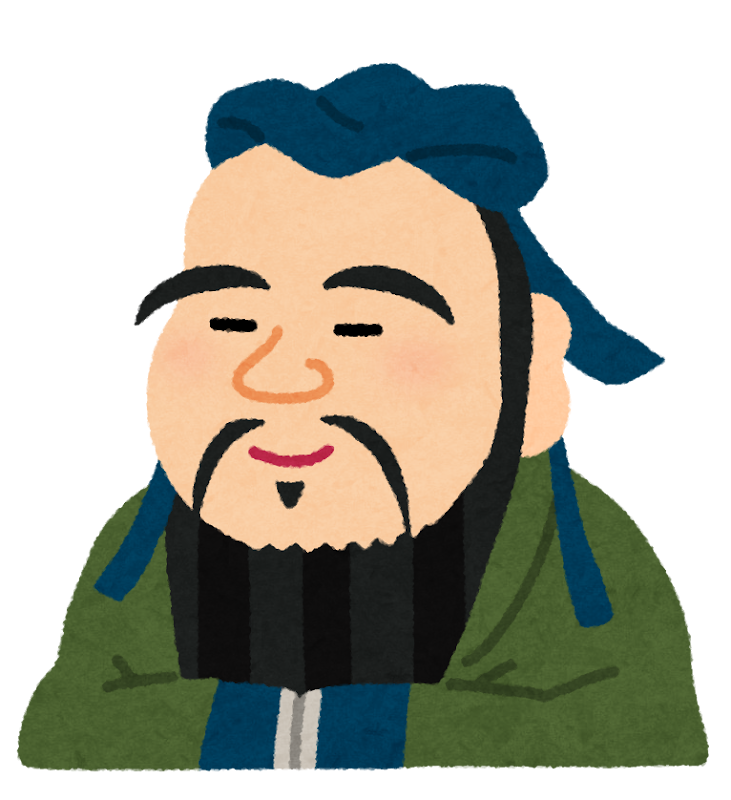
You’ve almost certainly heard the name “Confucius”; if it sounds oddly Latin for a Chinese philosopher, take it up with the Jesuits. His family name was 孔 Kong (reconstructed as either Khong or Klong in the pronunciation of his own time) and 夫子 fuzi means “sir, master”; “Kong fuzi” became “Confucius” in Latin transcription. His given name was 丘 Qiu (the ‘q’ is close to an English ‘ch’), so his proper name was Kong Qiu, but it would have been rude to call him this if you were not older than him. In ancient China, young men (and occasionally young women) were given a “courtesy name” when they came of age at 20. Most people who knew Confucius would have called him Kong Zhongni, 孔仲尼. Philosophical texts usually call him 孔子 “Master Kong” or even just 子 “the Master.” This translation says “the Master” where the text only has 子 and “Confucius” when it explicitly spells out any part of his name.
Note
子 zi is perhaps the most confusing character in the Chinese writing system. Its most literal meaning is “child, son/daughter.” But as a term of address, it shows respect, usually translated as “master.” And in Classical Chinese, it is often used as a polite pronoun for “you.” And in modern Mandarin, it’s often used as a meaningless noun affix, loosely, “thingie!” On top of all that, it’s a hugely common component in courtesy names, which is why we get “Ziqin asked Zigong…”
Yes, there are Classical Chinese sentences that use two or three of these together. Yes, I hate it.
Who was Confucius? Basically: just a random upper-middle-class Chinese guy who lived much longer ago than you think. Specifically, his birthyear is believed to be 551 BC – so half a millennium before Jesus Christ or Caesar Augustus. He got very fed up and disillusioned with government towards the end of his life, and started yapping everyone’s ear off about it. He did not achieve global philosophy rockstar status in his own lifetime, though he did have a dedicated band of students and was received as a guest by various kings and dukes. Dead guys sound inherently more authoritative, so he became more popular over time. Unlike most famous ancient people, we know exactly where his grave is, and who his direct descendents are today – in fact, the heir-to-heir bloodline of Confucius is the longest known family tree in the entire world. And yes, their family name is still 孔 Kong!
There’s one detail of his life that I think is critical context for understanding his philosophy: his father died when he was three years old. This meant, first, that his childhood was very hard without a direct provider and protector, and he appreciated the value of a loving father through bitter absence; second, that the only form of relationship he could have with his father was through the practice of ancestor worship; third, that he never experienced the inevitable conflicts between a son and a real, living, imperfect father, at least not from the son’s point of view (as he did become a father himself). I find this very insightful for understanding the roots of what I think is the single ugliest, least praiseworthy aspect of his philosophy: advocating for lying about your father’s crimes to protect him from justice.
“Confucianism” straddles the blurry line between philosophy and religion. It is mainly a philosophy about how society and family life is to be organized, but it was developed in a context where ancestor worship was already a presumed part of how you showed your family respect. As such, there are “Confucian” rituals, but there’s not really a “Confucian” pantheon or mythology; it blends with Chinese folk beliefs or whatever organized religion comes its way, and for example the Catholic church reluctantly tolerates Confucian funerals. Many people who participate in Confucian rituals today are thoroughly atheistic and do not believe in any sort of literal afterlife for their ancestors.
Warning
Confucianism and Taoism are two separate Chinese belief systems with some overlapping concepts and terminology. Critically, 道 “The Way” (transcribed as Dao or Tao) means whichever Way the philosopher advocates for – Jesus Christ also said 我就是道路 “I am the Way.” When Confucius speaks of the Way to live, it is not the same as the Taoist Way. There are philosophers who have tried to unify Confucianism and Taoism into one overarching Way, but others see them as irreconcilable.
The Analects is not a book written by Confucius, per se; rather, it is a collection of everything that anyone could remember him or his best students saying, written down hodge-podge after he died. As such, it does not present a cohesive narrative, and is not building towards any particular final argument; the episodes are not in chronological order and are grouped into chapters seemingly at random. Some of the entries towards the end of the book start to get suspiciously long and literary and fanfic-shaped. Some of the recollections are lacking in context and were already confusing even to the oldest surviving commentaries; no-one has ever understood why he was so mad about burial dolls, and no-one ever will.
Speaking of commentaries – it is impossible to disentangle the cultural weight of literal millennia of them from the pure, original text. The bare-bones quote collection format of the Analects means that it has always been presented with additional commentary and context (whether written or oral) from the time it first became a popular philosophy text over two thousand years ago. Add the fact that modern Chinese languages have drifted considerably from the Old Chinese of Confucius, and the idea of trying to read “just” the Analects with no commentary at all strikes the modern Chinese student as insane. This does, however, mean that famous Classical texts have a bit of an “extended cinematic universe” of traditional analyses that are treated as canonical, and the critical reader should consider that some of these analyses were mistaken about the original author’s intent or deliberately re-framing older texts within their own philosophy. (I, for one, am a very critical reader: the Confucian philosophy is not my queer-centric circus, not my feminist monkeys. I just like ancient writing systems.)
It’s not really possible to simply “let the text speak for itself” with no commentary whatsoever, especially in a western translation where the vast majority of readers haven’t bathed in the cultural background radiation of a society heavily influenced by Confucianism. So, please enjoy my commentary on the foundational text of Ritualized Patriarchy fully aware that I am, uh, a queer autistic pumpkin spice white girl whose father told her to never contact him again.
Many western translations make Classical texts even more patriarchal than they already are by needlessly gendering neutral terms, for example by rendering 人 “people” as “men” or consistently rendering non-gendered pronouns for nonspecific persons as “he”. You might have gotten the vibe that’s not really what I’m about.
There is a specific term Confucius frequently uses which is gendered masculine in its most literal sense, but he is using it in a developed, abstracted philosophical sense: 君子 junzi “the son of a lord,” often translated as “gentleman,” with the meaning of someone who is possessed of virtue, wisdom and dignity, like the son of a lord hypothetically should be. Another core Confucian text, with the awkwardly-translated conventional title Doctrine of the Mean (that’s “mean” as in “middle, mathematical average”), is clear that a peasant wife can be “the son of a lord” if she strives for virtue. ffs, James Legge, “intermeddle”? This is why I have to re-translate everything from scratch…
Since “noble” has had a parallel sense development in English, it seems an appropriate translation; I have chosen to phrase it in a non-gendered way, “the noble soul.” This is ‘soul’ in the secular sense of the inner human experience, not in any specifically religious sense.
My translation of a little episode from the historical narrative Zuo Zhuan should illustrate the literal vs philosophical senses of the term nicely:
Han Jue was driving his chariot in hot pursuit of the Lord of Qi. The lord’s own driver said “shoot that guy behind us! He’s a nobleman!”
The Lord of Qi answered, “calling him a noble man and then shooting him isn’t very polite!”
It also illustrates my approach to translation, because the translation on Wikipedia says that he declined to shoot “on the grounds of ritual propriety.” Excessively literal dictionary-licking translations are not illuminating: he meant it’d be rude. The text was not meant to be mysterious and arcane, it was meant to be understood. That said: the enormous time gaps and lack of context mean that the intended meaning is not always 100% clear. Some statements in the Analects have been translated in exactly opposite ways by qualified people. There is inherently some interpretation of intent by the translator (including translation to modern Chinese), and I strive to always comes up with an interpretation that makes sense and sounds like something a real guy would say, but you are fully within your rights to disagree on some specifics.
Note
The original text is given in black characters for Traditional and again in gray characters for Simplified. When phonetic spellings are given, they are in Modern Mandarin, like a schoolchild in Beijing would use in their philosophy class.
The punctuation of the original text has been westernized in most modern editions. They did not in fact use the “?” symbol in the Spring and Autumn era of ancient China, but they do in modern vernacular Chinese. I have copied this to help you understand the structure of the text. (We know when an ancient Chinese sentence is a question due to the presence of certain inquiring words, such as 乎 which is roughly “hmm?”)
Chapter 1
子曰:「學而時習之,不亦說乎?有朋自遠方來,不亦樂乎?人不知而不慍,不亦君子乎?」
子曰:「学而时习之,不亦说乎?有朋自远方来,不亦乐乎?人不知而不愠,不亦君子乎?」
(說 is understood as 悅)
The Master said: “Learning and having time to practice, doesn’t that sound nice? Friends coming from far away, wouldn’t that be lovely? Not minding a quiet existence, doesn’t that make one a noble soul?”
有子曰:「其為人也孝弟,而好犯上者,鮮矣;不好犯上,而好作亂者,未之有也。君子務本,本立而道生。孝弟也者,其為仁之本與!」
有子曰:「其为人也孝弟,而好犯上者,鲜矣;不好犯上,而好作乱者,未之有也。君子务本,本立而道生。孝弟也者,其为仁之本与!」
Master You said: “It’s hard to find someone who respects their parents and siblings, yet doesn’t respect their leaders; you’ll never find someone who never disrespects their leaders and yet gladly disturbs the public peace. The noble soul focuses on the fundamentals; the Way grows from healthy roots. Respecting your parents and siblings is the root of human dignity!”
Note
“You” is the name of someone else who spoke with Confucius. It is pronounced like “yo”, not like the English pronoun. It’s actually a very confusing name in Chinese too, because it literally means “to have”, and 有子曰 could be interpreted as “there was some random master who said…” But it’s definitely just a guy’s name here. Later, there is a second guy also named You, but written with a different character, so it’s not too wildly confusing in Chinese. (In their own time, the two names would have had a more distinct pronunciation; many sounds have merged in modern Mandarin.) Translations often substitute his courtesy name, Zilu – especially since Confucius greets him as “You!” Who’s on first?
子曰:「巧言令色,鮮矣仁!」
子曰:「巧言令色,鲜矣仁!」
The Master said: “Clever words and polished looks rarely go together with a sense of dignity!”
Note
The word I’m translating as “human dignity, sense of dignity” (仁 ren) is more commonly translated as “humaneness” or “benevolence”: that which is profoundly good and kind about human nature. The word is homonymous with 人 ren “person/people” (probably from a shared root along the lines of “heart, mind”) and is written as “person” and “two” squished together: person-to-person behavior. Some ancient sources wrote it as “person” plus “heart”.
曾子曰:「吾日三省吾身:為人謀而不忠乎?與朋友交而不信乎?傳不習乎?」
曾子曰:「吾日三省吾身:为人谋而不忠乎?与朋友交而不信乎?传不习乎?」
Master Zeng said: “Every day, I scrutinize myself on three points: Did I make plans with others and not follow through? Have I let down the trust of my friends? Have I failed to practice what I preach?”
子曰:「道千乘之國:敬事而信,節用而愛人,使民以時。」
子曰:「道千乘之国:敬事而信,节用而爱人,使民以时。」
The Master said: “The Way to manage a modest kingdom is to foster respect and trust, to spend carefully, to love your people, and not overwork them.”
子曰:「弟子入則孝,出則弟,謹而信,汎愛眾,而親仁。行有餘力,則以學文。」
子曰:「弟子入则孝,出则弟,谨而信,泛爱众,而亲仁。行有余力,则以学文。」
The Master said: “Behind closed doors, a child should respect their parents; when outside, they should respect anyone older than themselves. They should be sincere and trustworthy, abound with love for others, and cherish human dignity. Once all this is mastered, then they may learn to read.”
Note
The word 文 wen (which is perhaps my favorite character) encompasses the meanings of writing, literature, culture, civilization, and “civilian” as the opposite of “military.” The modern definition of a “civilization” (as opposed to a pre-civilized society) considers the most important difference to be the invention of writing – the ancient Chinese had already drawn this connection as vital thousands of years ago.
子夏曰:「賢賢易色,事父母能竭其力,事君能致其身,與朋友交言而有信。雖曰未學,吾必謂之學矣。」
子夏曰:「贤贤易色,事父母能竭其力,事君能致其身,与朋友交言而有信。虽曰未学,吾必谓之学矣。」
Zixia said: “If someone marries for virtue over beauty, would do anything for their parents, would give their life for their country, is a good friend and trustworthy, but is uneducated – actually, they sound quite educated to me.”
子曰:「君子不重則不威,學則不固。主忠信,無友不如己者,過則勿憚改。」
子曰:「君子不重则不威,学则不固。主忠信,无友不如己者,过则勿惮改。」
The Master said: “The noble soul must take things seriously; without serious purpose, learning will be hollow. Master loyalty and trustworthiness; avoid friendships with people who are not doing the same. Do not fear correcting a mistake.”
曾子曰:「慎終追遠,民德歸厚矣。」
曾子曰:「慎终追远,民德归厚矣。」
Master Zeng said: “Holding funerals and remembering ancestors replenishes the people’s sense of virtue.”
Note
Confucian burial rites aren’t as “one-and-done” as most western ones – the complete traditional process for laying your father or mother to rest takes three years. The excessive costs and lack of productivity (that’s six years of your life tied up in performative grieving, during which time many activities are forbidden) were a point of criticism among other schools of thought; the Confucian argument is that if you aren’t willing to sacrifice to honor your parents, you’re barely even human.
One supposes that lower-class working people could not simply take three years off from work no matter how much they loved their parents, which creates a self-reinforcing reason for the educated classes to look down on them as ignoble souls.
子禽問於子貢曰:「夫子至於是邦也,必聞其政,求之與?抑與之與?」子貢曰:「夫子溫、良、恭、儉、讓以得之。夫子之求之也,其諸異乎人之求之與?」
子禽问于子贡曰:「夫子至于是邦也,必闻其政,求之与?抑与之与?」子贡曰:「夫子温、良、恭、俭、让以得之。夫子之求之也,其诸异乎人之求之与?」
Ziqin asked Zigong: “When the Master arrives in a country, he inevitably gets told the whole political situation. Does he openly seek this information out? Or does it just happen?” Zigong answered: “The Master is gentle, honest, polite, restrained and helpful, so he gets whatever he needs. Why, what do other people do when they need something?”
Note
In the Spring and Autumn era (named for their custom of keeping record books titled the Springs and Autumns of XYZ) and the subsequent Warring States era (named for all the wars), there was no “China,” there was only dozens of small kingdoms with closely interrelated languages and cultures. Even an old man like Confucius could amble from one country to the next in a wagon, but being openly nosy about the local politics could easily get him accused of spying. There were so many minor kings rising and falling that today, 王 Wang “King” is one of the most common family names.
Part of the function of the Chinese writing system was to paper over local variations in spoken language, so that the same document could be read by people from different ends of the Chinese cultural zone with minimal difficulty.
子曰:「父在,觀其志;父沒,觀其行;三年無改於父之道,可謂孝矣。」
子曰:「父在,观其志;父没,观其行;三年无改于父之道,可谓孝矣。」
The Master said: “While your father is alive, observe his intentions; when your father is gone, follow his path. If you can walk his Way for three years without straying, you can say you have honored his memory.”
有子曰:「禮之用,和為貴。先王之道斯為美,小大由之。有所不行,知和而和,不以禮節之,亦不可行也。」
有子曰:「礼之用,和为贵。先王之道斯为美,小大由之。有所不行,知和而和,不以礼节之,亦不可行也。」
Master You said: “When carrying out a ritual, a graceful bearing is crucial. This is what made the Way of former kings so beautiful in matters great and small. But one who is graceful knows when grace does not suit the ritual, and that grace itself is not the ritual.”
I’ve noticed disagreement on whether 小大由之 (“in matters great and small”) belongs to the “former kings” sentence or the following one. (The distinction between periods and commas is modern editing.) It doesn’t make any difference to the overall point.
有子曰:「信近於義,言可復也;恭近於禮,遠恥辱也;因不失其親,亦可宗也。」
有子曰:「信近于义,言可复也;恭近于礼,远耻辱也;因不失其亲,亦可宗也。」
Master You said: “Trust is the aspect of justice which fulfills promises; respect is the aspect of ritual that drives out disgrace. Hold them close, and you will be admired.”
子曰:「君子食無求飽,居無求安,敏於事而慎於言,就有道而正焉,可謂好學也已。」
子曰:「君子食无求饱,居无求安,敏于事而慎于言,就有道而正焉,可谓好学也已。」
The Master said: “The noble soul does not eat to feel full or stay home to feel comfort. They handle everyday life with good sense and care. Pointed straight down the Way, they are already learning well.”
子貢曰:「貧而無諂,富而無驕,何如?」子曰:「可也。未若貧而樂,富而好禮者也。」子貢曰:「《詩》云:『如切如磋,如琢如磨。』其斯之謂與?」子曰:「賜也,始可與言詩已矣!告諸往而知來者。」
子贡曰:「贫而无谄,富而无骄,何如?」子曰:「可也。未若贫而乐,富而好礼者也。」子贡曰:「《诗》云:『如切如磋,如琢如磨。』其斯之谓与?」子曰:「赐也,始可与言诗已矣!告诸往而知来者。」
We are informed that 賜 is Zigong’s given name (as opposed to courtesy name).
Zigong asked: “What do you think of poor people who are not too servile and rich people who are not too entitled?” The Master said: “Those are good traits; even better is someone who is poor and happy, or rich and respectful.” Zigong said: “Everyone knows the poem: ‘Chiseled and polished by blade and stone.’ Is that the sort of thing you mean?” The Master said: “My dear, you are ready to speak in terms of poetic metaphor! I spoke literally and you anticipated the line.”
Some editions say “someone who is poor and on the Way” rather than happy, which strikes me as a scholar so stodgy they can’t believe Confucius would recommend being happy…
Note
The literal text here is “The Odes say: …” which is alluding to a set of over three hundred poems (also translated as the Classic of Poetry) which were assembled into a book by interviewing the common people for their favorite songs, and were already centuries old in Confucius’s time. The specific poem is about the qualities of a good prince, and this anecdote informs us of the ancient scholarly analysis of the line: that painful experiences can shape you into what you’re meant to be.
Tradition claims that the specific edition of the Odes we have today was personally edited by Confucius, who removed some (few thousand!) morally unsuitable folk songs. This is probably just made up on the basis that he is history’s most famous Odes-enjoyer. There are also definitely still some spicy folk songs in the collection, which has led to centuries of tortured explanations for why it’s actually a metaphor for something perfectly virtuous and it’s you, the reader, who has a dirty mind.
子曰:「不患人之不己知,患不知人也。」
子曰:「不患人之不己知,患不知人也。」
I’m amused by the rare sentence with absolutely no differences between Traditional and Simplified script at all.
The Master said: “It doesn’t bother me if people do not know of me; it bothers me if I don’t know of them.”
Chapter 2
子曰:「為政以德,譬如北辰,居其所而眾星共之。」
子曰:「为政以德,譬如北辰,居其所而众星共之。」
共 is understood as 拱
The Master said: “Governing through virtue makes one the North Star, the axle that turns the whole sky.”
子曰:「詩三百,一言以蔽之,曰『思無邪』。」
子曰:「诗三百,一言以蔽之,曰『思无邪』。」
The Master said: “There are three hundred Odes, but one key point: think no evil.”
子曰:「道之以政,齊之以刑,民免而無恥;道之以德,齊之以禮,有恥且格。」
子曰:「道之以政,齐之以刑,民免而无耻;道之以德,齐之以礼,有耻且格。」
The Master said: “The Way of governance uses punishment to prevent people doing something shameful, but the Way of virtue uses culture to teach people why something is shameful.”
Note
禮 li is primarily translated as ritual/rite, including some examples in this translation, but I felt here it was misleading. “Ritual” sounds excessively religious in a modern lens, but “social convention” sounds excessively clinical. Saying “good morning” is ritual; thank-you cards are ritual. Manners, dinner etiquette, grieving, holidays – these are all included in “ritual.”
子曰:「吾十有五而志于學,三十而立,四十而不惑,五十而知天命,六十而耳順,七十而從心所欲,不踰矩。」
子曰:「吾十有五而志于学,三十而立,四十而不惑,五十而知天命,六十而耳顺,七十而从心所欲,不逾矩。」
The Master said: “At fifteen, I was focused on learning; at thirty, I was independent; at forty I was free of confusion; at fifty, I knew what Heaven wanted; at sixty, I was listening more closely; at seventy, my heart’s desires were what they should be.”
孟懿子問孝。子曰:「無違。」樊遲御,子告之曰:「孟孫問孝於我,我對曰『無違』。」樊遲曰:「何謂也?」子曰:「生事之以禮;死葬之以禮,祭之以禮。」
孟懿子问孝。子曰:「无违。」樊迟御,子告之曰:「孟孙问孝于我,我对曰『无违』。」樊迟曰:「何谓也?」子曰:「生事之以礼;死葬之以礼,祭之以礼。」
Meng Yizi asked how to respect one’s parents. The Master said: “Don’t be against them.” Afterwards, Fanchi was giving the Master a ride home, and asked him to elaborate. The Master said: “While they are alive, treat them with every honor; when they die, bury them with every honor; when you remember them, ascribe to them every honor.”
Note
The conventional translation of 孝 xiao is “filial piety,” but no-one says that in English outside of stilted translations of Confucian texts.
孟武伯問孝。子曰:「父母唯其疾之憂。」
孟武伯问孝。子曰:「父母唯其疾之忧。」
Meng Wubo asked why to respect one’s parents. The Master said: “Your father and mother worry about your health more than their own.”
Note
We are informed by traditional commentary that Meng Wubo is the son of Meng Yizi. These two anecdotes back-to-back paint a vivid picture of that evening’s lecture, don’t they?
子游問孝。子曰:「今之孝者,是謂能養。至於犬馬,皆能有養;不敬,何以別乎?」
子游问孝。子曰:「今之孝者,是谓能养。至于犬马,皆能有养;不敬,何以别乎?」
Ziyou asked about respecting one’s parents. The Master said: “These days, just making sure they don’t starve is called ‘respecting’ your parents. But we also make sure dogs and horses don’t starve. Shouldn’t respect be more than the bare minimum?”
子夏問孝。子曰:「色難。有事弟子服其勞,有酒食先生饌,曾是以為孝乎?」
子夏问孝。子曰:「色难。有事弟子服其劳,有酒食先生馔,曾是以为孝乎?」
Zixia asked about respecting one’s parents. The Master said: “A good attitude is the hardest part. Just going through the motions of doing chores for elders or offering them food before you eat, does that sound sufficiently respectful?”
子曰:「吾與回言終日,不違如愚。退而省其私,亦足以發。回也,不愚。」
子曰:「吾与回言终日,不违如愚。退而省其私,亦足以发。回也,不愚。」
The Master said: “I’d speak with Hui all day, and he’d just nod along like an idiot. But in his personal life, he showed that he grasped exactly what to do. Hui wasn’t an idiot.”
Note
This is the first mention of Yan Hui (pronounced like Hway), but the rest of the Analects make clear that Hui was Confucius’s favorite student, whose relatively young death grieved him deeply.
Grammatically, Classical Chinese is very uninterested in specifying if something happened in the present or the past. You could just as well translate “Hui isn’t an idiot,” but I imagine this is something Confucius said in reminiscence, long after he had died.
子曰:「視其所以,觀其所由,察其所安。人焉廋哉?人焉廋哉?」
子曰:「视其所以,观其所由,察其所安。人焉廋哉?人焉廋哉?」
The Master said: “You can see what people do, where they go, and when they rest. How can people hide? How can people hide?”
Note
The emphatic repetition in some of Confucius’s quotes really captures that they were said aloud in dialogue and not written as an essay. Also, this one sounds a little unhinged, not gonna lie.
子曰:「溫故而知新,可以為師矣。」
子曰:「温故而知新,可以为师矣。」
The Master said: “A teacher is someone who recalls the old but also understands the new.”
子曰:「君子不器。」
子曰:「君子不器。」
The Master said: “The noble soul is not a tool of one use.”
If you think you saw me chucking dictionaries at the head of everyone who ever translated this as “the gentleman is not a utensil,” no you didn’t.
子貢問君子。子曰:「先行其言,而後從之。」
子贡问君子。子曰:「先行其言,而后从之。」
Zigong asked about noble souls. The Master said: “They do not say what they mean to do, but say what they have done.”
子曰:「君子周而不比,小人比而不周。」
子曰:「君子周而不比,小人比而不周。」
The Master said: “The noble soul is inclusive and not competitive. Petty people are competitive and not inclusive.”
James Legge did you seriously translate “the superior man is CATHOLIC” here okay yes I know it ‘technically’ has a secular definition but what the hell you can’t just say superior men are catholic
子曰:「學而不思則罔,思而不學則殆。」
子曰:「学而不思则罔,思而不学则殆。」
The Master said: “Learning without thinking will leave you confused. Thinking without learning will leave you in peril.”
子曰:「攻乎異端,斯害也已!」
子曰:「攻乎异端,斯害也已!」
The Master said: “Starting from a strange premise leads to harmful conclusions!”
Note
Confucius said to cool it with the ethical thought experiments that make you conclude funding AI is literally infinitely more important than anything that’s literally killing real people right this second.
子曰:「由!誨女知之乎?知之為知之,不知為不知,是知也。」
子曰:「由!诲女知之乎?知之为知之,不知为不知,是知也。」
女 is understood as 汝 here and in most other occurrences
The Master said to Zhong You: “Shall I teach you what ‘knowledge’ means? Knowing what you know, and knowing what you do not know – that is knowledge.”
子張學干祿。子曰:「多聞闕疑,慎言其餘,則寡尤;多見闕殆,慎行其餘,則寡悔。言寡尤,行寡悔,祿在其中矣。」
子张学干禄。子曰:「多闻阙疑,慎言其余,则寡尤;多见阙殆,慎行其余,则寡悔。言寡尤,行寡悔,禄在其中矣。」
Zizhang was studying to become an official. The Master told him: “Be skeptical of what you hear, be cautious in what you report, and you will make few mistakes; consider carefully what you see and think carefully over what to do, and there will be little to regret. If you make few mistakes and foster few regrets, you will reach your goal and become an official.”
哀公問曰:「何為則民服?」孔子對曰:「舉直錯諸枉,則民服;舉枉錯諸直,則民不服。」
哀公问曰:「何为则民服?」孔子对曰:「举直错诸枉,则民服;举枉错诸直,则民不服。」
Duke Ai asked: “How do I ensure the people will want to work?” Confucius answered: “Uplift the righteous and condemn the unjust, and the people will work; uplift the unjust and condemn the righteous, and the people will refuse to work.”
季康子問:「使民敬、忠以勸,如之何?」子曰:「臨之以莊則敬,孝慈則忠,舉善而教不能,則勸。」
季康子问:「使民敬、忠以劝,如之何?」子曰:「临之以庄则敬,孝慈则忠,举善而教不能,则劝。」
Ji Kangzi asked: “How can I fill the people with respect, loyalty and diligence?” The Master said: “Oversee them firmly, and they will be respectful; treat them like beloved family, and they will be loyal; lift up the good and teach the rest, and they will be diligent.”
或謂孔子曰:「子奚不為政?」子曰:「《書》云:『孝乎惟孝、友于兄弟,施於有政。』是亦為政,奚其為為政?」
或谓孔子曰:「子奚不为政?」子曰:「《书》云:『孝乎惟孝、友于兄弟,施于有政。』是亦为政,奚其为为政?」
Someone asked Confucius: “Master, why don’t you work for the government?” The Master said: “As they say in the Book of Documents – ‘Only respect for elders, and friendship between brothers young and old, is needed for government.’ Therefore, I am governing; why do I need to ‘work for’ the government?”
Note
The Book of Documents is the Analects of the Analects: an even older collection of random anecdotes attributed to respected figures. (Confucius literally calls it just “The Book.”) Centuries after Confucius’s death, someone claimed to have found the “real” Book of Documents with “lost” chapters hidden in the ruins of Confucius’s house! Of course, the “lost” chapters were fabricated fanfic, as was already suspected even at the time. In the 1600s, scholar Yan Rouqu was able to carry out a stunning act of linguistic and cultural analysis to conclusively prove it. This closely parallels how the Second Book of Kings claims that one of Josiah’s priests found the “real” Bible in the ruins of the Temple – a cover story to justify why a new synthesized edition did not precisely match anyone’s older edition.
Whether this rando was asking “Master, why do you settle for teaching when you could be making good money in government?” or “Master, if you’re really so right about everything then why can’t you land a job?” is open to interpretation. (Confucius did work in government when he was younger, until he ragequit. Something about a lord spending a week straight in the ‘dance hall’…)
子曰:「人而無信,不知其可也。大車無輗,小車無軏,其何以行之哉?」
子曰:「人而无信,不知其可也。大车无輗,小车无軏,其何以行之哉?」
The Master said: “I don’t know how untrustworthy people even get by. It’s like a wagon with no yoke or a chariot with no reins. How would they get anything done?”
子張問:「十世可知也?」子曰:「殷因於夏禮,所損益,可知也;周因於殷禮,所損益,可知也;其或繼周者,雖百世可知也。」
子张问:「十世可知也?」子曰:「殷因于夏礼,所损益,可知也;周因于殷礼,所损益,可知也;其或继周者,虽百世可知也。」
(殷 Yin was a capital of the 商 Shang Dynasty)
Zizhang asked: “What can we know of ten generations hence?” The Master said: “The Shang followed the rites of the Xia, while changing them slightly; we know of this. The Western Zhou followed the rites of the Shang, while changing them slightly; we know of this. Since then, all have inherited the ways of the Zhou, and after a hundred generations these ways will still be known.”
Note
The Shang (already several centuries before Confucius) are the oldest Chinese royal dynasty that definitely really did exist as described, as the oldest surviving Chinese writing (the Oracle Bones) were written by the Shang court. According to ancient sources, their predecessors were called the Xia, who may or may not have literally existed – we’re talking four thousand years ago at this point.
We are currently exactly 80 generations out from Confucius. We’re getting close to fulfilling his claim in broad strokes (since we still have a good amount of knowledge of his cultural practices, and some rituals are still practiced to this day), but there’s still time for something to go catastrophically wrong…
子曰:「非其鬼而祭之,諂也。見義不為,無勇也。」
子曰:「非其鬼而祭之,谄也。见义不为,无勇也。」
The Master said: “Praying to someone else’s ancestor is cringe. Not doing what you know is right is cowardly.”
YES, “CRINGE.” I AM DOING WHAT I KNOW IS RIGHT BECAUSE I’M NOT A COWARD
If you need a cowardly translation, substitute “cringing” or “servile”
Chapter 3
孔子謂季氏:「八佾舞於庭,是可忍也,孰不可忍也?」
孔子谓季氏:「八佾舞于庭,是可忍也,孰不可忍也?」
Confucius said of the Ji clan: “They have EIGHT teams of dancers in their court! If we tolerate this, what line is left to cross?”
Note
… This is very “kids these days”: he means that’s too many dancers for someone who’s not a king, and is applying a slippery slope argument that it begins with too many dancers and ends with a long and bloody rebellion to overthrow the king (the “Son of Heaven”). Confucius put enormous emphasis on outwardly following ritual rules (in this case, how many dancers you may keep on hand, based on your rank) to demonstrate your inner commitment to social order.
三家者以雍徹。子曰:「『相維辟公,天子穆穆』,奚取於三家之堂?」
三家者以雍彻。子曰:「『相维辟公,天子穆穆』,奚取于三家之堂?」
The Three Families of Lu were singing the Song of Harmony. Confucius quoted it back at them: “‘The nobility are mere servants, to the Son of Heaven belongs the glory.’ You lot really have some nerve singing that in your own temples!”
Note
Performing this song was the Son of Heaven’s job. “The Three Families” includes the Ji of eight-dance-squads fame, so this is painting a picture of Confucius just following these people he can’t stand around, parroting their own words back to them in mOcKiNg CaSe…
子曰:「人而不仁,如禮何?人而不仁,如樂何?」
子曰:「人而不仁,如礼何?人而不仁,如乐何?」
The Master said: “If people had no human dignity, what would be the point of human culture? If people had no human dignity, what would be the point of playing music?”
林放問禮之本。子曰:「大哉問!禮,與其奢也,寧儉;喪,與其易也,寧戚。」
林放问礼之本。子曰:「大哉问!礼,与其奢也,宁俭;丧,与其易也,宁戚。」
I understand 易 as 賜, “given from above” (ie the rules)
Lin Fang asked what is most fundamental in rituals. The Master answered: “What a good question! With rituals, simplicity is better than spectacle; with funerals, the grief is more important than the ritual rules.”
子曰:「夷狄之有君,不如諸夏之亡也。」
子曰:「夷狄之有君,不如诸夏之亡也。」
The Master said: “A barbarian state with a ruler is not as good as a civilized state even when it lacks a ruler.”
Note
I did him a favor and replaced the specific culture names with the generic ideas he’s using them to symbolize, but he’s definitely being racist. (They’re ancient names, no-one identifies by them anymore.)
季氏旅於泰山。子謂冉有曰:「女弗能救與?」對曰:「不能。」子曰:「嗚呼!曾謂泰山,不如林放乎?」
季氏旅于泰山。子谓冉有曰:「女弗能救与?」对曰:「不能。」子曰:「呜呼!曾谓泰山,不如林放乎?」
The Ji clan presumed to perform the Tai Mountain ritual. The Master pleaded with one of their advisors, Ran You: “Can’t you talk them out of this?” Ran You replied “I cannot.” The Master lamented: “For pity’s sake! If the gods of Tai Mountain tolerate this, their understanding of ritual is inferior to Lin Fang!”
Note
The idea here is that the Tai Mountain ritual is only for the lord acknowledged as “The Son of Heaven,” so the Ji clan have in fact slipped down that slope from eight entire dance squads. The pluck of openly complaining that gods these days don’t have as much self-respect as some random guy you know is very funny to me… (Lin Fang asked Confucius a question a few entries back. Perhaps we’re to understand that Ran You interrupted the lecture to announce this shocking turn of events, and Confucius pointed at the last rando to ask him about ritual as a comparison?)
子曰:「君子無所爭,必也射乎!揖讓而升,下而飲,其爭也君子。」
子曰:「君子无所争,必也射乎!揖让而升,下而饮,其争也君子。」
The Master said: “The noble soul is not competitive; take archery for example! The participants bow to one another when it is their turn, and drink together afterwards. That’s how one nobly competes.”
子夏問曰:「『巧笑倩兮,美目盼兮,素以為絢兮。』何謂也?」子曰:「繪事後素。」曰:「禮後乎?」子曰:「起予者商也!始可與言詩已矣。」
子夏问曰:「『巧笑倩兮,美目盼兮,素以为绚兮。』何谓也?」子曰:「绘事后素。」曰:「礼后乎?」子曰:「起予者商也!始可与言诗已矣。」
商 is Zixia’s given name.
Zixia asked about a poem: “‘Her smile wise with whimsy, her eyes bright with beauty, she is plain silk to be adorned.’ What does it mean?” The Master said: “You can’t paint until you have a canvas.” Zixia mused: “Culture is layered on something else?” The Master exclaimed: “I’ve underestimated you, my dear! You are now ready to discuss poetry.”
See, his given name can be translated as “estimate, appraise” so I worked in a pun…
子曰:「夏禮,吾能言之,杞不足徵也;殷禮,吾能言之,宋不足徵也。文獻不足故也,足則吾能徵之矣。」
子曰:「夏礼,吾能言之,杞不足征也;殷礼,吾能言之,宋不足征也。文献不足故也,足则吾能征之矣。」
The Master said: “I can speak on ancient Xia culture, but I lack hard evidence from their homeland; I can speak on ancient Shang culture, but I lack hard evidence from their homeland. They did not leave enough written records; if only I had more to work with!”
Note
The oldest Chinese writing of any kind that still exists today is from the Shang dynasty – specifically, oracular carvings on bones, which last much longer than the more usual bamboo or silk. As such, it is very hard to say when Chinese writing actually began, as the evidence has all rotted away. Confucius seems to take it for granted that the Xia before the Shang did have writing, but he already had the same problem!
子曰:「禘自既灌而往者,吾不欲觀之矣。」
子曰:「禘自既灌而往者,吾不欲观之矣。」
My reading without commentarial context:
The Master said: “When the king performs a royal sacrifice, first he pours out the wine, and then I can’t bear to see what comes next.” (That is, the part where an animal dies slowly and in pain.)
My reading according to what the commentaries say prompted this remark (you guessed it, someone cosplaying king again (with the explicit permission of the king, which doesn’t seem to affect Confucius’s opinion of the situation – “the gods of Tai Mountain are chumps” and all that)):
The Master said: “When the supposedly royal sacrifice was ‘performed’, first they poured out the wine, and then I was loathe to bear witness to this travesty.”
A good example of how heavily the standard commentaries affect the understood meaning.
或問禘之說。子曰:「不知也。知其說者之於天下也,其如示諸斯乎!」指其掌。
或问禘之说。子曰:「不知也。知其说者之于天下也,其如示诸斯乎!」指其掌。
Someone then asked why such sacrifices need be performed. The Master said: “I don’t know! Anyone who could understand would have the whole world-” He pointed emphatically at his own hand- “in the palm of their hands!”
Note
I take this as implying Confucius is aware that sacrifices are cruel, but he has reasoned that whoever started such a shocking ritual must have had a very good reason beyond his mortal grasp. Modern people have a tendency to tar ancient peoples with the bloodstained brush of “brutal, violent, lacking respect for life.” It sounds like Confucius was bothered by the animal’s suffering – he just sincerely believed that the suffering caused by sparing it would be even worse.
Confucius’s most famous intellectual successor, Mengzi (Mencius), relates that he knew a king who was so moved by the pitiful wails of an ox during a routine sacrifice that he demanded the priests release it immediately and replace it with a sheep. Mengzi told the king that the only difference was that he left before he had to see the sheep, but he’d inevitably want to spare that one too, because good people don’t want living creatures to die just because it’s convenient – which leads into calling for the abolishment of war.
祭如在,祭神如神在。子曰:「吾不與祭,如不祭。」
祭如在,祭神如神在。子曰:「吾不与祭,如不祭。」
Worship like they’re in front of you – worship like the gods are right in front of you! The Master said: “If I do not attend the worship ceremony, it might as well not have happened.”
王孫賈問曰:「與其媚於奧,寧媚於竈,何謂也?」子曰:「不然,獲罪於天,無所禱也。」
王孙贾问曰:「与其媚于奥,宁媚于灶,何谓也?」子曰:「不然,获罪于天,无所祷也。」
The princeling Jia mused: “How does that saying go – you’re better off praying to your stove than your shrine?” The Master said: “That’s not true. If you offend Heaven, nothing else will answer you.”
Note
This isn’t necessarily “atheism” by the strictest definition – as folk religion would have supposed the existence of kitchen spirits – but Jia’s folk saying is very much an assertion that people have real, immediate concerns that won’t be fixed by appeasing some abstract “guys in the sky.” Confucius clearly disagrees, but he wouldn’t have had to say this at all unless “gods, schmods” was a common sentiment – another thing that goes against the common modern perception of ancient cultures.
子曰:「周監於二代,郁郁乎文哉!吾從周。」
子曰:“周监于二代,郁郁乎文哉!吾从周。”
The Master said: “The Zhou could look back on the previous two dynasties; what an utterly magnificent civilization they then made! I follow the ways of the Zhou.”
(Xia → Shang → Zhou → “Spring and Autumn,” Confucius’s time which lacked clear central power)
子入大廟,每事問。或曰:「孰謂鄹人之子知禮乎?入大廟,每事問。」子聞之曰:「是禮也。」
子入大庙,每事问。或曰:「孰谓鄹人之子知礼乎?入大庙,每事问。」子闻之曰:「是礼也。」
The Master entered the Grand Temple and asked a great many questions. Someone remarked: “Who said this backwater bumpkin is supposed to be an expert on ritual? He’s wandering around the Grand Temple asking about all the rituals!” Hearing them, Confucius said “This is the ritual.”
子曰:「射不主皮,為力不同科,古之道也。」
子曰:「射不主皮,为力不同科,古之道也。」
The Master said: “Archery isn’t about who is born the strongest, but something more fair – so is the ancient Way.”
子貢欲去告朔之餼羊。子曰:「賜也,爾愛其羊,我愛其禮。」
子贡欲去告朔之饩羊。子曰:「赐也,尔爱其羊,我爱其礼。」
Zigong wished to abolish the monthly sacrifice of sheep. The Master said, “My dear, you love the sheep; I love the ritual.”
Note
Again, I don’t think Confucius is mocking the idea of caring about the suffering of sheep, but believes that the ritual is far more important. Because if he allowed himself to realize the suffering is not accomplishing its stated goal and yet he’s been participating in it, he’d have a breakdown. That’s how cruelty reproduces.
愛 is very straightforwardly “love” in its most primary definition, but it’s sometimes used in senses more like “begrudge, loathe to lose,” so it’s often taken that Zigong is concerned about the economic value of the sheep. I do think this is about the sheep as a living being that can feel pain (perhaps in addition to the economic waste) – see the story of Mengzi and the ox above.
子曰:「事君盡禮,人以為諂也。」
子曰:「事君尽礼,人以为谄也。」
The Master said: “When you follow every rule for serving your lord perfectly, people will think you grossly servile.”
(well yeah…)
定公問:「君使臣,臣事君,如之何?」孔子對曰:「君使臣以禮,臣事君以忠。」
定公问:「君使臣,臣事君,如之何?」孔子对曰:「君使臣以礼,臣事君以忠。」
Duke Ding asked: “How should a lord and his ministers treat one another?” Confucius answered: “The lord should treat his ministers with every courtesy, and the ministers should serve their lord with loyalty.”
子曰:「關雎,樂而不淫,哀而不傷。」
子曰:「关雎,乐而不淫,哀而不伤。」
關 is not literal here, but phonetic *kwaen for “quack” or “honk”, two of the least poetic words in the English language
The Master said: “Within the Odes you’ll find ‘The Call of Waterbirds,’ which is joyful but not gleeful, grieving but not aggrieved.”
哀公問社於宰我。宰我對曰:「夏后氏以松,殷人以柏,周人以栗,曰使民戰栗。」子聞之曰:「成事不說,遂事不諫,既往不咎。」
哀公问社于宰我。宰我对曰:「夏后氏以松,殷人以柏,周人以栗,曰使民战栗。”子闻之曰:「成事不说,遂事不谏,既往不咎。」
is 我 “I/me” the most confusing personal name ever? We’ll let You decide
Duke Ai asked Zai Wo what type of wood to use when honoring the God of the Land. Zai Wo answered: “The Xia used pine, the Shang used cypress, and the Zhou used chestnut, because their word for it sounded like ‘trembling’ and they thought the people should tremble.” Confucius interjected: “There’s no point dwelling on what’s done, water under the bridge, no need to assign blame!”
Note
… This appears to be Confucius having a panic attack that someone pointed out his beloved perfect Zhou made a decision based on a pun rather than following established convention. So, are the eight teams of dancers “water under the bridge,” or?
子曰:「管仲之器小哉!」或曰:「管仲儉乎?」曰:「管氏有三歸,官事不攝,焉得儉?」「然則管仲知禮乎?」曰:「邦君樹塞門,管氏亦樹塞門;邦君為兩君之好,有反坫,管氏亦有反坫。管氏而知禮,孰不知禮?」
子曰:「管仲之器小哉!」或曰:「管仲俭乎?」曰:「管氏有三归,官事不摄,焉得俭?」「然则管仲知礼乎?」曰:「邦君树塞门,管氏亦树塞门;邦君为两君之好,有反坫,管氏亦有反坫。管氏而知礼,孰不知礼?」
The Master remarked “Prime Minister Guan Zhong had a really small ‘jug,’ if you know what I mean!” Someone guessed: “… You mean he was frugal?” Confucius scoffed. “The man had three houses, three wives, a three-tiered tower and too many servants to keep busy! That’s your idea of frugal?” “Then… do you mean he was well-cultured?” Confucius said: “A lord may have a privacy screen in front of his gate, and Guan Zhong rudely imitated this; a lord may have a ceremonial cup stand when entertaining other lords as a guest, and Guan Zhong rudely imitated this. If that’s ‘well-cultured,’ then who isn’t well-cultured?”
Note
Sources differ on whether 三归 “three things to return to” means Guan Zhong had three wives, three fiefdoms or a three-tier tower, so I decided that naturally he had all three for maximum thematic alignment. Guan Zhong was well-respected, hence the confused guessing at a positive connotation.
Confucius said Guan Zhong had a small “container of liquid”. A small “capacity to pour out”. A small “tool”. A small “utensil one would keep handy”. This is definitely a metaphor for his virtue.
子語魯大師樂。曰:「樂其可知也:始作,翕如也;從之,純如也,皦如也,繹如也,以成。」
子语鲁大师乐。曰:「乐其可知也:始作,翕如也;从之,纯如也,皦如也,绎如也,以成。」
The Master was speaking with the Master of Music from the state of Lu. He said: “This is the one thing to know about music: the first note should sound in unison; from there, it should be simple and clear, developing complexity towards the conclusion.”
Note
Unfortunately the ancients went and LOST all their copies of the Classic of Music that perhaps defined technical senses of these words, which makes this statement particularly hard to translate; interpretations diverge wildly.
You may have noticed that 樂(乐) is sometimes translated “music” and sometimes as “happiness.” In Old Chinese, music (reconstructed *[ŋ]ˤrawk) was an inflected form of joy (reconstructed *[r]ˤawk) and early writers clearly did not find it confusing to simply use the same character (which depicts strings + wood = musical instrument). In modern Mandarin, the pronunciations have diverged to yuè for music and lè for joy; they’re usually used in compounds that disambiguate the reading. How do you know which reading to use in Classical Chinese? Uhhh, vibes, mostly.
儀封人請見。曰:「君子之至於斯也,吾未嘗不得見也。」從者見之。出曰:「二三子,何患於喪乎?天下之無道也久矣,天將以夫子為木鐸。」
仪封人请见。曰:「君子之至于斯也,吾未尝不得见也。」从者见之。出曰:「二三子,何患于丧乎?天下之无道也久矣,天将以夫子为木铎。」
The gate guard of Yi sent an invitation: “I insist on meeting all worthy people coming through this place.” After the meeting, his parting words were “All of you, why dwell on your sorrows? The world has long lost its Way, and Heaven will ring your master like a bell.”
子謂韶,「盡美矣,又盡善也。」謂武,「盡美矣,未盡善也」。
子谓韶,「尽美矣,又尽善也。」谓武,「尽美矣,未尽善也」。
The Master said of Shao-style music, “Perfectly beautiful, and morally good.” Of Wu-style music he said, “Perfectly beautiful, but not quite morally good.”
I mentioned they lost track of the Classic of Music, right? As such, no-one has any idea what the music he liked or disliked is supposed to sound like.
子曰:「居上不寬,為禮不敬,臨喪不哀,吾何以觀之哉?」
子曰:「居上不宽,为礼不敬,临丧不哀,吾何以观之哉?」
The Master said: “Wielding power without tolerance, holding ceremonies without respect, attending funerals without grief – how could I bear to witness such things!”
you have read faster than I can translate. please stand by…